Science Highlights¶
the maxwell cluster occasionally plays an important role in scientific investigations, and subsequent publications. We have collected quite a list of impressive publications referencing the Maxwell Cluster, and are grateful for any additional references (we certainly have missed some). The latest additions can be found here, a complete list can be found under Science Highlights
Visualizing and Quantifying Rembrandt’s Smalt Mixtures in The Night Watch in Three Dimensions Using μ-X-ray Fluorescence Tomography¶
| Smalt is one of the main blue pigments in Rembrandt van Rijn’s The Night Watch (1642). Smalt is a cobalt-containing potash glass, ground to a powder to be used as an artists’ pigment. In this study, three smalt-containing paint samples from this painting were studied using synchrotron radiation-based micro-X-ray fluorescence (SR-μ-XRF) tomography. To study the original intentions of the artist, the degradation phenomena taking place in the paint and the best preservation methods for the painting, a fuller understanding of the smalt-containing paint mixtures is desired. The smalt particles in Rembrandt’s paints show a wide variety in size and elemental composition. Elements related to smalt are, e.g., cobalt, potassium, arsenic, bismuth, nickel, and iron. The heterogeneity is very high among the particles within one paint sample. Different clusters of particles can be established based on the intensity of bismuth. This variety could be caused by heterogeneity in the cobalt ore, the glass-making process, the use of multiple types of smalt or it might be the result of in-situ degradation. Next to the smalt, the volume percentages taken up by other components of the paint are semi quantitively estimated based on elemental information. This information can be used in follow-up studies to improve the accuracy of models and the representativeness of reconstructed paint mockup samples. SR-μ-XRF tomography proves to be a valuable tool for the identification and quantification of complex heterogenous smalt paints. Fréderique T. H. Broers et al. |  |
Pressure-Dependent Diffusion of PEG-Functionalized Gold Nanoparticles Probed by X-ray Photon Correlation Spectroscopy
| Dynamic properties of nanoparticles under high pressure are poorly understood due to experimental challenges. Here, we use X-ray photon correlation spectroscopy (XPCS) to investigate the diffusion dynamics of polyethylene glycol (PEG)-functionalized gold nanoparticles dispersed in water at pressures up to 6 kbar. Complementary small-angle X-ray scattering reveals no measurable pressure-induced changes in the gold core size, confirming structural stability across the studied pressure range. XPCS measurements show a systematic slowing down of nanoparticle dynamics with increasing pressure, with relaxation rates retaining the expected q2-dependence characteristic of Brownian motion. The extracted diffusion coefficients decrease continuously with pressure and align with predictions based on the pressure-dependent viscosity of water and the Stokes–Einstein relation, assuming a constant hydrodynamic particle size. Within experimental uncertainty, no additional contribution from pressure-induced ligand-shell modifications is observed in these dilute dispersions. The Journal of Physical Chemistry B Nele N. Striker et al. |  |
Rapid Inverse GISAXS Analysis of Nanoparticle Assemblies with Simulation-Trained Deep Learning
| Nanostructured materials, particularly those formed through nanoparticle deposition or self-assembly on thin film surfaces, are critical to numerous advanced applications due to their exceptional physical and chemical properties. Grazing-incidence small-angle X-ray scattering (GISAXS) has become an indispensable technique for characterizing the morphology of these nanostructures, offering detailed insights into electron density distributions at both the surface and within the film. However, extracting structural information from GISAXS data remains challenging, largely due to the phase problem. Conventional methods typically involve fitting to experimental data using predetermined, simplified models. The process is both time-consuming and constrained by the limited variety of the available models, often resulting in oversimplified descriptions parameterized by a single size and a polydispersity parameter. Moreover, convergence difficulties become more challenging for GISAXS data fits when using traditional regression algorithms compared with transmission SAXS data. To address these limitations within a well-defined model system, we use the distorted wave Born approximation (DWBA) to simulate a diverse library of 2D GISAXS patterns for supported gold nanoparticle assemblies. These simulated datasets are used to train a convolutional neural network (CNN) that predicts the joint nanoparticle height–radius distribution from GISAXS patterns. On simulated validation data, the form-factor branch achieves mean relative errors of 13.8% for particle height and 11.2% for radius, while experimental CNN-predicted mean radii deviate from SEM-derived values by 18.5% and 17.9% for two Au nanoparticle films. After offline training, CPU inference requires approximately 44 ms per 256 × 256 GISAXS pattern, enabling millisecond-scale analysis without iterative fits. These results demonstrate a rapid, model-specific workflow for GISAXS-based nanoparticle size-distribution analysis. Yufeng Zhai et al. |  |
Discovery of Goethe’s amber ant: its phylogenetic and evolutionary implications¶
| Museum collections remain essential scientific resources, especially when revisited using modern analytical techniques. In an interdisciplinary study, we examined the overlooked amber collection of Johann Wolfgang von Goethe (1749–1832), polymath and pioneer of art and natural science. Using synchrotron-based micro-computed tomography (SR-µ-CT), we identified a fossil ant from Baltic amber (Eocene ~ 47–34 Ma) in Goethe’s collections. The specimen is assigned to †Ctenobethylus goepperti (Mayr in Die Ameisen des Baltischen Bernsteins. Beiträge zur Naturkunde Preussens, 1868), which we redescribe and re-diagnose, proposing †Eldermyrmex exsectus Dubovikoff et Dlussky, 2019 as its junior synonym (syn. nov., comb. nov.). We further infer a potential sister-group relationship with the extant genus Liometopum Mayr, 1861, suggesting that †C. goepperti may have been a dominant arboreal species in warm-temperate coniferous forests, a scenario which is supported by its abundance in Baltic amber. Critically, our results document endoskeletal structures in a Cenozoic fossil ant, underscoring both the morphological value of historical collections and the lasting scientific legacy of Goethe’s naturalist vision. Brendon E. Boudinot et al. | 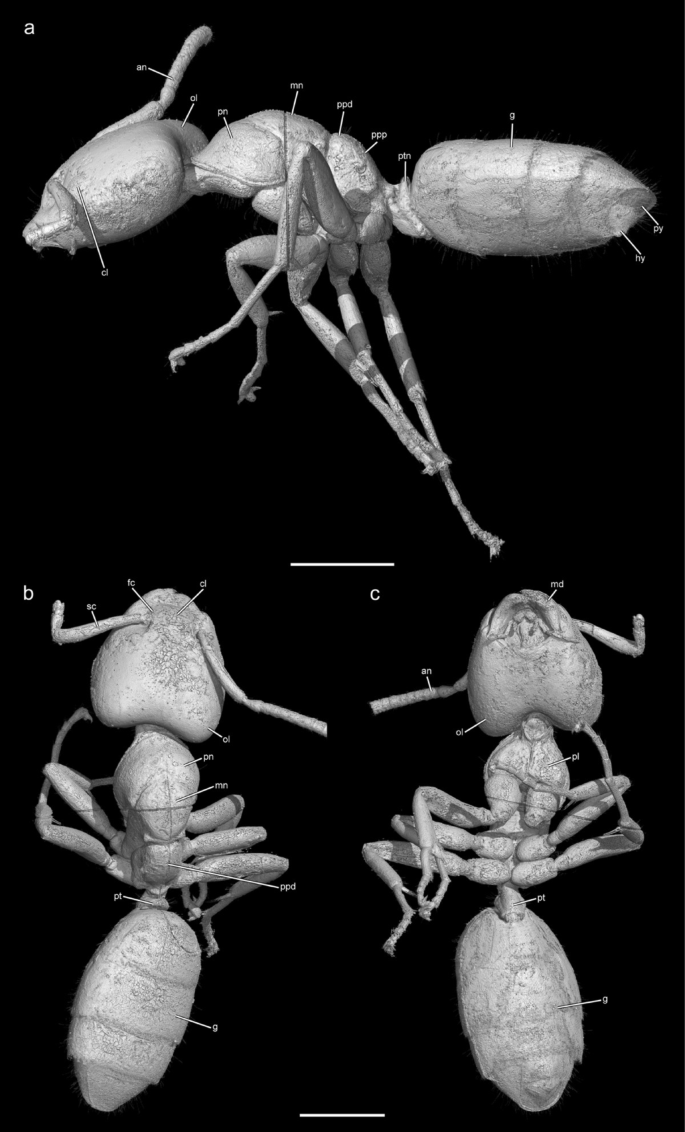 |
Active energy compression of a laser-plasma electron beam¶
| Radio-frequency (RF) accelerators providing high-quality relativistic electron beams are an important resource enabling many areas of science, as well as industrial and medical applications. Two decades ago, laser-plasma accelerators that support orders of magnitude higher electric fields than those provided by modern RF cavities produced quasi-monoenergetic electron beams for the first time. Since then, high-brightness electron beams at gigaelectronvolt (GeV) beam energy and competitive beam properties have been demonstrated from only centimetre-long plasmas, a substantial advantage over the hundreds of metres required by RF-cavity-based accelerators. However, despite the considerable progress, the comparably large energy spread and the fluctuation (jitter) in beam energy still effectively prevent laser-plasma accelerators from driving real-world applications. Here we report the generation of a laser-plasma electron beam using active energy compression, resulting in a performance so far only associated with modern RF-based accelerators. Using a magnetic chicane, the electron bunch is first stretched longitudinally to imprint an energy correlation, which is then removed with an active RF cavity. The resulting energy spread and energy jitter are reduced by more than an order of magnitude to below the permille level, meeting the acceptance criteria of a modern synchrotron, thereby opening the path to a compact storage ring injector and other applications. Nature P. Winkler et al. | 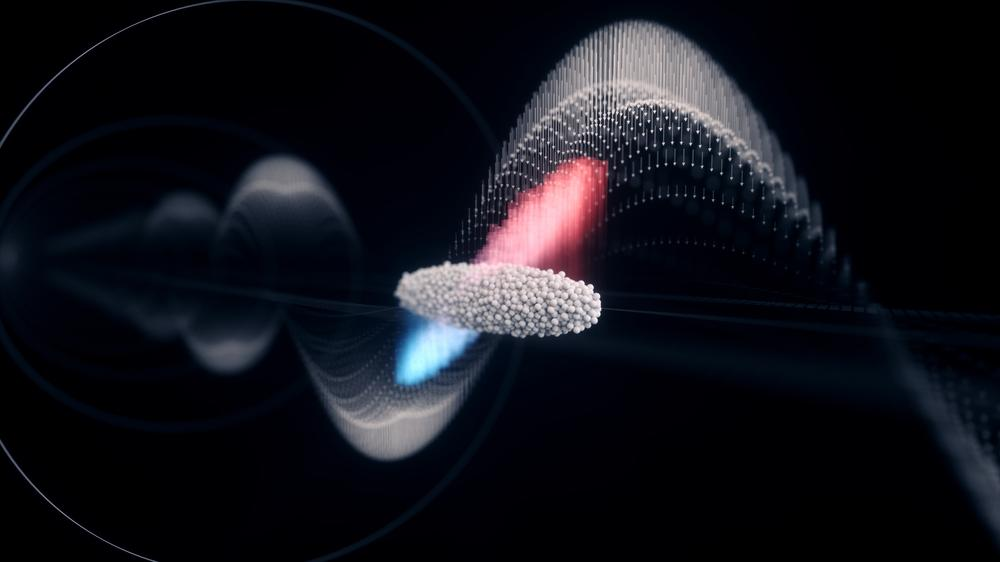 |